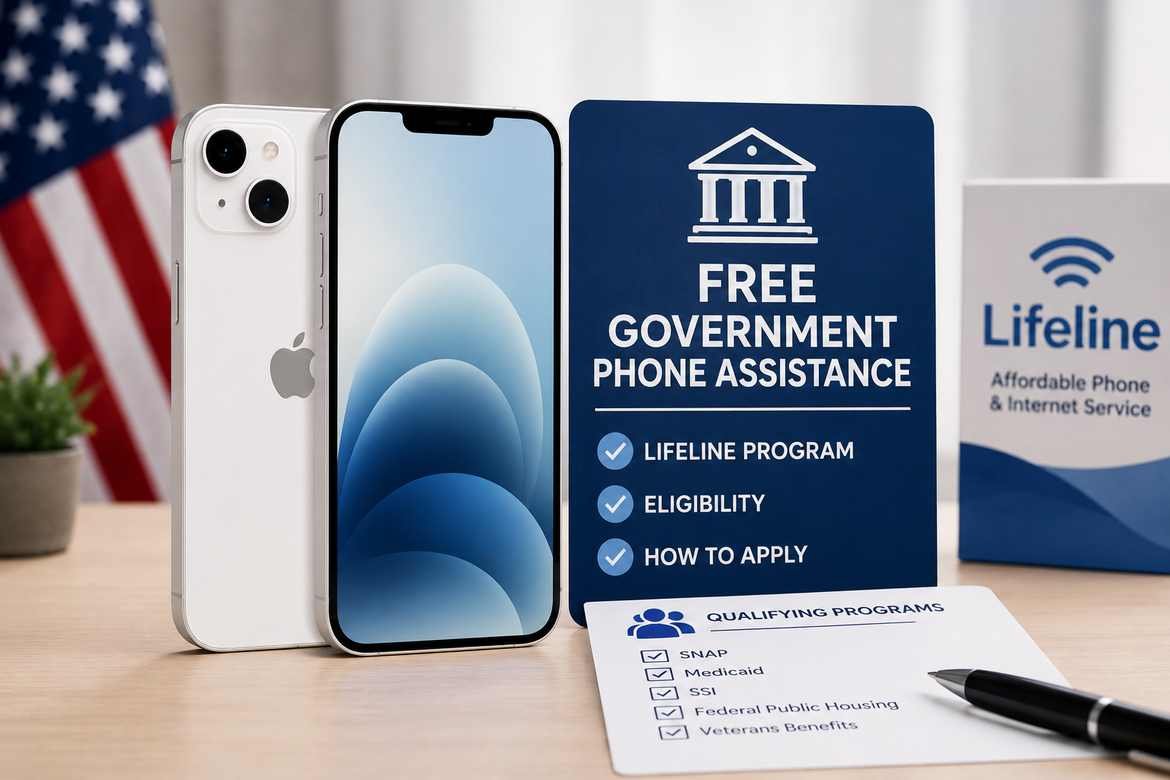
If you’re searching for a free iPhone government phone, there’s an important distinction to understand before you apply: the federal government does not guarantee every eligible person a free iPhone.
The main federal program to know about is Lifeline, which helps qualifying low-income consumers reduce the cost of phone or internet service. In 2026, the standard Lifeline benefit can provide up to $9.25 per month, while eligible consumers living on qualifying Tribal lands can receive up to $34.25 per month.
A participating wireless provider may offer a phone with Lifeline service, but the government benefit itself does not promise a particular iPhone model—or even an iPhone at all. Device availability depends on the provider, your location, current inventory, and the provider’s terms.
Here’s how the process works and what you should check before applying.
Can You Get a Free iPhone Through a Government Phone Program?
Possibly, but a free iPhone is not guaranteed by the federal Lifeline program.
Lifeline is primarily a service discount, not a federal iPhone giveaway. If you qualify, the benefit can reduce the cost of eligible phone or internet service. You then choose a participating company that offers Lifeline in your area.
Whether that company offers:
- a free phone,
- an iPhone,
- an Android smartphone,
- a discounted device, or
- BYOD (bring your own device)
is determined by the provider’s current offer and requirements.
So if you specifically want an iPhone, don’t assume that Lifeline approval automatically means you’ll receive one.
What Is the Lifeline Program?
Lifeline is a federal program administered by the Universal Service Administrative Company (USAC) under the oversight of the Federal Communications Commission (FCC).
Its purpose is to make qualifying phone and internet services more affordable for eligible consumers.
For eligible consumers in most of the United States, the standard benefit is:
| Lifeline benefit | Maximum monthly discount |
|---|---|
| Standard Lifeline | Up to $9.25 |
| Enhanced Tribal Lifeline | Up to $34.25 |
The larger benefit is available to qualifying consumers living on eligible Tribal lands.
Lifeline is not the same as a free-phone guarantee
This is the part many advertisements blur.
The federal program provides a service benefit. A participating company may have its own device offers.
Therefore:
Lifeline approval ≠ guaranteed free iPhone.
Your provider may determine what phones are available when you enroll.
Does Lifeline Guarantee a Free iPhone?
No.
Lifeline’s official materials describe the program in terms of reducing the cost of eligible phone or internet service. They do not establish a rule giving every qualified applicant a specific iPhone model.
That means you should be cautious with websites making claims such as:
- “Everyone gets a free iPhone.”
- “The government guarantees an iPhone.”
- “Choose any iPhone for free.”
- “Get the latest iPhone from the government.”
Those statements should not be treated as universal Lifeline rules.
What can change your device options?
Device availability can depend on:
- your state or service area,
- the participating provider,
- current inventory,
- the provider’s current device offer,
- whether you qualify for the provider’s particular offer,
- whether you already have a compatible phone,
- and other provider-specific terms.
For that reason, check the provider’s current terms before assuming a particular iPhone is available.
Who Is Eligible for Lifeline?
There are several ways to qualify.
USAC currently says consumers can qualify based on household income or participation in certain qualifying government assistance programs.
1. Income-based eligibility
Your gross household income must be at or below 135% of the Federal Poverty Guidelines.
The 2026 limits are different for the contiguous 48 states and D.C., Alaska, and Hawaii.
2. Qualifying government programs
You may also qualify if you or an eligible member of your household participates in certain programs, including:
- SNAP
- Medicaid
- Supplemental Security Income (SSI)
- Federal Public Housing Assistance (FPHA)
- Veterans Pension and Survivors Benefit
Additional Tribal programs can qualify eligible consumers living on Tribal lands.
Tribal program eligibility
For eligible households on Tribal lands, additional qualifying programs include:
- Bureau of Indian Affairs General Assistance
- Tribal TANF
- Tribal Head Start, subject to the applicable income requirement
- Food Distribution Program on Indian Reservations (FDPIR)
2026 Lifeline Income Limits
USAC’s current 2026 table uses 135% of the Federal Poverty Guidelines.
| Household size | 48 states, D.C. & territories | Alaska | Hawaii |
|---|---|---|---|
| 1 | $21,546 | $26,933 | $24,786 |
| 2 | $29,214 | $36,518 | $33,602 |
| 3 | $36,882 | $46,103 | $42,417 |
| 4 | $44,550 | $55,688 | $51,233 |
| 5 | $52,218 | $65,273 | $60,048 |
| 6 | $59,886 | $74,858 | $68,864 |
| 7 | $67,554 | $84,443 | $77,679 |
| 8 | $75,222 | $94,028 | $86,495 |
| Each additional person | +$7,668 | +$9,585 | +$8,816 |
These figures are specifically for 2026 and should be updated when USAC publishes new annual guidelines.
Example
Suppose a household of four in the contiguous United States has gross household income of $40,000.
The 2026 income threshold shown by USAC for four people is $44,550. On that basis, the household would be below the published income threshold.
However, this is only an illustrative example, not an eligibility determination. The official application process determines whether the applicant qualifies.
How to Apply for Lifeline
Getting the service benefit and getting a particular phone are two separate parts of the process.
A practical approach is:
Step 1: Check whether you qualify
Start by determining whether you qualify through:
- household income, or
- a qualifying government assistance program.
USAC’s eligibility rules provide the current requirements.
Step 2: Apply through the National Verifier
The National Verifier is Lifeline’s centralized application system. USAC manages it and uses it to determine consumer eligibility.
Consumers can apply themselves online, apply with help from a participating company, or use a paper application.
Apply for Lifeline through the official Lifeline Support website
Step 3: Provide additional documentation if requested
The National Verifier can automatically check identity, address and eligibility information against available databases.
If your information cannot be verified automatically, you may be asked to provide additional documentation.
Depending on the situation, this could involve documentation showing:
- participation in a qualifying program,
- household income,
- identity, or
- address.
Don’t upload sensitive documents to a website simply because it advertises a “free iPhone.” Use the official application process or a legitimate participating provider.
Step 4: Find a participating provider
After applying, choose a phone or internet company that offers Lifeline in your area.
USAC’s Companies Near Me tool allows consumers to search by ZIP code or city and state.
Find Lifeline companies near you
Step 5: Ask about current phone options
This is where the iPhone question becomes important.
Before enrolling, ask the provider:
- Do you currently offer an iPhone?
- Is the iPhone free or does it require an additional payment?
- Which model is currently available?
- Is the device offer available in my ZIP code?
- Can I bring my own unlocked iPhone instead?
- Are there activation or other charges?
- What service plan is required?
Don’t rely on an old article or social-media post for device availability.
Step 6: Activate your service
Once you’ve selected a participating provider and completed its enrollment requirements, follow the provider’s instructions for activating service.
Lifeline itself is the benefit; the provider handles the actual mobile service and any device it offers.
How to Find a Lifeline Provider in Your Area
There isn’t one universal list of companies that guarantees the same phone offers nationwide.
USAC provides a Companies Near Me tool that lets consumers search for Lifeline providers using their ZIP code or city and state.
This is particularly useful because provider availability can vary geographically.
One important limitation: USAC warns that the search results may not show every nearby company, and appearing in the results does not necessarily mean the company can serve your exact address. Consumers should confirm availability directly with the provider.
A better way to compare providers
Don’t compare providers based only on the words “free phone.”
Check:
| What to compare | Why it matters |
|---|---|
| Current device | Determines whether an iPhone is actually available |
| Monthly service | A free device doesn’t necessarily mean every service is free |
| Data allowance | Important if you use mobile data heavily |
| Talk/text | Confirm what’s included |
| Network/service area | Availability depends on location |
| BYOD support | Useful if you already own an iPhone |
| Activation requirements | May affect your initial cost |
| Device restrictions | Important if you want to switch providers later |
| Current offer terms | Promotions and inventory can change |
Can You Use Your Own iPhone?
Potentially, yes.
If you already own an iPhone, asking about BYOD (Bring Your Own Device) may be a better option than waiting for a provider to have an iPhone available.
The key question is whether your particular iPhone is compatible with the provider’s service.
Before switching, ask the provider to verify:
- device compatibility,
- whether the phone is unlocked,
- SIM/eSIM compatibility,
- activation requirements,
- and whether the device can be used with the specific Lifeline plan.
This can be especially useful if you already have a relatively recent iPhone and don’t need another handset.
What If a Lifeline Provider Doesn’t Offer an iPhone?
Don’t assume you’ve reached a dead end.
You have several possibilities.
Option 1: Check another participating provider
Use the official Companies Near Me tool to identify other Lifeline companies serving your area.
Option 2: Use your existing iPhone
Ask whether the provider supports your device through BYOD.
Option 3: Consider another smartphone
If your main goal is affordable smartphone service rather than specifically owning an iPhone, an Android device may give you more options.
Option 4: Consider a non-government phone deal
If you don’t qualify for Lifeline—or if the available device isn’t suitable—compare regular prepaid and carrier promotions instead.
The important thing is to distinguish a government assistance benefit from a commercial carrier promotion.
Common Mistakes to Avoid
Mistake 1: Assuming Lifeline guarantees an iPhone
It doesn’t.
Lifeline provides an eligible service discount. A provider’s device offer is a separate issue.
Mistake 2: Using an outdated income table
Lifeline income limits change as the Federal Poverty Guidelines are updated.
For 2026, use USAC’s current figures rather than an old blog post.
Mistake 3: Applying for multiple Lifeline benefits
Only one Lifeline benefit is allowed per household. USAC defines a household based on people at the same address who share income and household expenses.
Mistake 4: Confusing the ACP with Lifeline
The Affordable Connectivity Program is not an active enrollment program. The FCC ended the ACP on June 1, 2024 after funding ran out.
If a website currently asks you to “apply for the ACP” as though it were accepting new applicants, be extremely cautious.
Mistake 5: Trusting a device promise without reading the terms
A page saying “free iPhone” may be referring to a limited provider offer rather than a universal government benefit.
Always check the current provider terms.
Free Government iPhone Scams to Watch For
Searches for free government iPhone can attract misleading advertisements because the phrase sounds like a guaranteed government giveaway.
Be cautious when a website:
- promises a specific new iPhone without explaining eligibility;
- claims the government guarantees a particular model;
- asks for unnecessary sensitive information;
- uses government-looking graphics without being an official government site;
- says you must pay a large “government application fee”;
- claims the ACP is currently accepting new applications;
- doesn’t identify the participating service provider;
- provides no clear terms and conditions.
A safer approach
Start with the official Lifeline system and then verify the provider.
The official Lifeline website explains the application process, participating companies and eligibility requirements.
What Happened to the Affordable Connectivity Program?
This is worth explaining because outdated articles can create confusion.
The Affordable Connectivity Program (ACP) ended on June 1, 2024 because Congress did not provide additional funding. The FCC announced the program’s end in May 2024.
That means an article published years ago may still contain instructions telling consumers to apply for ACP benefits.
Those instructions are outdated unless the program is legally reauthorized.
Lifeline is a separate program and remains active. USAC currently lists Lifeline as an active federal program providing a monthly benefit for eligible consumers.
Who Is a Government-Assisted iPhone Option Best For?
This type of assistance can make sense for someone who:
- has limited household income;
- receives a qualifying government benefit;
- needs affordable phone service;
- wants to reduce monthly wireless costs;
- is willing to consider the phone options actually available from participating providers;
- already owns an iPhone and may be able to use it through BYOD.
The biggest benefit is affordable connectivity, not necessarily getting a particular premium smartphone.
Who Should Not Expect a Free iPhone?
You should adjust your expectations if your only goal is:
“I want a specific iPhone model for $0.”
Lifeline doesn’t establish a right to a particular handset.
If a specific iPhone is your priority, you may need to compare:
- current Lifeline provider device offers;
- BYOD options;
- refurbished iPhones;
- prepaid carrier promotions;
- manufacturer financing;
- regular carrier switcher promotions.
Those are separate from the federal Lifeline benefit.
Pros and Cons
| Pros | Cons |
|---|---|
| Can reduce eligible phone or internet costs | Does not guarantee a free iPhone |
| Available to qualifying low-income households | Device selection varies |
| Several ways to qualify | Provider availability varies by location |
| Official eligibility system | Applications may require additional documentation |
| Tribal households may receive an enhanced benefit | Rules and offers can change |
| Existing phones may be usable through BYOD | A specific iPhone model may not be available |
Final Verdict
If you’re searching for a free iPhone government phone, the most important thing to know is that Lifeline is a service-assistance program, not a federal program that guarantees every eligible person a free iPhone.
If you qualify, Lifeline can currently provide up to $9.25 per month toward eligible phone or internet service, or up to $34.25 per month for qualifying consumers on Tribal lands.
The best approach is:
1. Check your Lifeline eligibility → 2. Apply through the official process → 3. Find participating providers in your ZIP code → 4. Ask about current iPhone availability → 5. Consider BYOD if you already own an iPhone.
Most importantly, don’t choose a provider solely because an advertisement says “free iPhone.” Verify the current device, service, eligibility and other terms before giving a company your personal information.
FAQ
Can I really get a free iPhone through the government?
Not as a guaranteed federal benefit. Lifeline helps eligible consumers reduce the cost of qualifying phone or internet service. A participating provider may offer a phone, but Lifeline does not guarantee a specific iPhone.
Does Lifeline give you a free iPhone?
No. Lifeline is a monthly service benefit. Whether a participating provider offers a free device—and which devices are available—is determined by the provider’s current terms and availability.
Who qualifies for a free government phone?
Lifeline eligibility can be based on household income at or below 135% of the Federal Poverty Guidelines or participation in qualifying programs such as SNAP, Medicaid, SSI, Federal Public Housing Assistance, and Veterans Pension and Survivors Benefit. Additional Tribal programs can apply to eligible consumers living on Tribal lands.
What are the 2026 Lifeline income limits?
For a one-person household in the 48 contiguous states, D.C. and territories, the 2026 threshold is $21,546. For a four-person household, it is $44,550. Alaska and Hawaii have higher limits.
Can I use my own iPhone with Lifeline?
Potentially. You should ask a participating provider whether your iPhone is compatible with its network and Lifeline service. BYOD availability is provider-specific.
Where can I apply for Lifeline?
You can apply through the official Lifeline application process. USAC says consumers can apply online, with assistance from a participating phone or internet company, or by mail.
Is the Affordable Connectivity Program still available?
No. The FCC ended the ACP on June 1, 2024 because additional funding was not provided.
Can everyone in my household get Lifeline?
No. Generally, only one Lifeline benefit is allowed per household. USAC defines a household as people living at the same address who share income and household expenses
