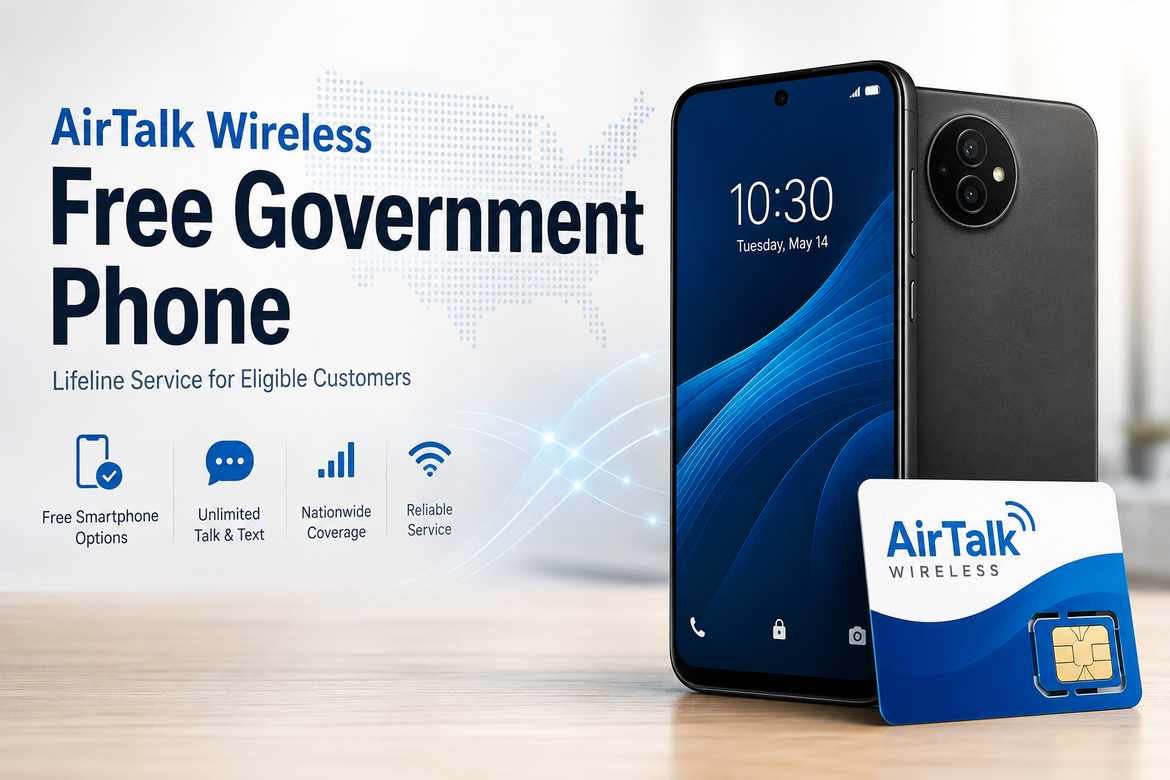
If you’re searching for an AirTalk Wireless free government phone, you may be able to get free or discounted wireless service and, depending on your eligibility, location, and the current offer, a free smartphone through AirTalk Wireless’ Lifeline service. AirTalk is an Eligible Telecommunications Carrier (ETC) that participates in the federal Lifeline program. The exact phone, data allowance, and plan available to you can vary by state, ZIP code, inventory, and current promotions.
Lifeline itself is a federal program administered through the Universal Service Administrative Company (USAC) that helps qualifying low-income consumers afford phone or internet service. Eligibility can be based on household income or participation in qualifying programs such as SNAP, Medicaid, or SSI.
This guide explains AirTalk Wireless eligibility, current Lifeline requirements, available plans, documentation, the application process, free-phone availability, and what to do if your application runs into problems.
Does AirTalk Wireless Offer a Free Government Phone?
Yes, AirTalk Wireless currently advertises free smartphone offers for eligible Lifeline customers, but the exact device and service offer are not guaranteed nationwide.
AirTalk’s current enrollment page says eligible applicants can check available offers by entering their ZIP code. Its site currently displays free-device offers and states that offers vary by state and are subject to availability.
The important distinction is that Lifeline is the federal benefit; AirTalk Wireless is the participating provider offering qualifying service and provider-specific device promotions.
USAC says Lifeline provides eligible consumers with a monthly benefit toward qualifying phone or internet service.
So, don’t assume that qualifying for Lifeline automatically guarantees a particular iPhone, Samsung Galaxy, or other model.
What Is AirTalk Wireless?
AirTalk Wireless is a wireless provider that participates in the federal Lifeline program as an Eligible Telecommunications Carrier.
Its current government-benefit pages describe AirTalk as a Lifeline provider and explain that eligible customers can receive supported wireless service. AirTalk also states that Lifeline service is limited to one benefit per household and requires identity and eligibility documentation.
The service is designed for consumers who qualify under the federal Lifeline program.
Your eligibility can generally be established through:
- Household income
- SNAP
- Medicaid
- Supplemental Security Income (SSI)
- Federal Public Housing Assistance
- Veterans and Survivors Pension Benefit
- Certain qualifying Tribal programs
USAC maintains the authoritative eligibility requirements.
How the AirTalk Wireless Free Government Phone Program Works
There are two parts to understand:
1. The federal Lifeline benefit
Lifeline is a federal assistance program that helps qualifying consumers pay for eligible communications services.
USAC currently states that the Lifeline benefit can provide up to $9.25 per month, or up to $34.25 per month for qualifying consumers on Tribal lands.
2. AirTalk’s provider-specific offer
AirTalk can use the Lifeline benefit to provide qualifying service and may offer eligible customers free or discounted devices.
AirTalk currently advertises free smartphones, but its own terms make clear that availability can depend on the customer’s state, ZIP code, inventory, and current offer.
Important distinction
The federal government does not promise every Lifeline customer a specific smartphone model.
The free-device portion is tied to the provider’s current offer and availability.
That is why one applicant might see a particular device while another applicant in a different location sees different choices.
Who Is Eligible for an AirTalk Wireless Free Government Phone?
You generally need to qualify for the Lifeline program before receiving Lifeline-supported service through AirTalk.
USAC says consumers can qualify through either income or participation in a qualifying government program.
Income-Based Eligibility
For 2026, a household may qualify if its gross household income is at or below 135% of the Federal Poverty Guidelines.
For the 48 contiguous states, Washington, D.C., and U.S. territories, the 2026 figures are:
| Household size | Maximum annual income |
|---|---|
| 1 | $21,546 |
| 2 | $29,214 |
| 3 | $36,882 |
| 4 | $44,550 |
| 5 | $52,218 |
| 6 | $59,886 |
| 7 | $67,554 |
| 8 | $75,222 |
| Each additional person | +$7,668 |
Alaska and Hawaii have different income limits, so residents there should use the current USAC figures rather than applying the table above.
Program-Based Eligibility
You may qualify without using the income pathway if you participate in an eligible program.
SNAP
The Supplemental Nutrition Assistance Program (SNAP) is one of the federal programs that can qualify a consumer for Lifeline.
Medicaid
Medicaid participation can also qualify an eligible household member for Lifeline.
Supplemental Security Income
SSI is another qualifying program.
Federal Public Housing Assistance
Consumers participating in Federal Public Housing Assistance may qualify.
Veterans and Survivors Pension Benefit
USAC also lists Veterans and Survivors Pension Benefit as a qualifying pathway.
Tribal Programs
Additional qualifying programs apply to eligible consumers on Tribal lands. The requirements and benefit amount can differ from standard Lifeline assistance.
Can Two People in the Same Household Get Lifeline?
Usually, only one Lifeline benefit is allowed per household.
USAC explicitly states that only one Lifeline benefit is allowed per household.
The important point is that “household” doesn’t simply mean everyone who happens to live at the same address.
The Lifeline rules use household circumstances involving people who share income and household expenses.
If two adults live at the same address but are financially independent households, special rules may apply. Don’t submit multiple applications simply because multiple people live at the same address.
What AirTalk Wireless Plans Are Available?
AirTalk’s current plans page shows that Lifeline offerings can differ by location.
For example, the current California listings include a $0 Lifeline Data Boost Plan with 25GB of high-speed data followed by unlimited data at reduced speeds, and a $0 Lifeline Standard Plan with 12GB of high-speed data. The page also displays paid upgrade options.
AirTalk’s current plan information also lists features such as:
- Unlimited talk
- Unlimited text
- International calling to more than 200 countries and territories
- Free SIM or eSIM
- Wi-Fi calling
- Nationwide coverage claims
- Customer support
However, individual features and allowances should be checked against the plan actually displayed for your location.
Why you should check your ZIP code
AirTalk explicitly says its offers vary by state and instructs applicants to enter their ZIP code to check local availability.
Therefore, there is no single nationwide AirTalk plan that should automatically be assumed to apply to every customer.
Does AirTalk Wireless Offer a Free Smartphone?
Yes, AirTalk currently advertises free-phone offers for eligible customers.
Its current free-phone page says that free-phone offers are available to new and eligible former customers and displays devices whose price can vary by region.
AirTalk’s enrollment page also currently displays examples of Apple, Samsung, and other devices at $0 under its promotional free-phone offer.
However, this does not mean every applicant can select every device.
AirTalk says:
- Offers vary by state.
- Availability can be limited.
- Specific models can change.
- Device availability depends on stock.
What phones can you get?
The models displayed on AirTalk’s website can change. Current pages have displayed examples including:
- Apple iPhone models
- Samsung Galaxy models
- TCL devices
- Alcatel devices
- Other Android smartphones
Because inventory changes, don’t publish a permanent list of “the free AirTalk phones” without checking the live device catalog first.
How to Apply for an AirTalk Wireless Free Government Phone
AirTalk’s current application process can be summarized into three broad stages: complete the application, wait for review and approval, and then receive and use the service/device.
Step 1: Check Your ZIP Code
Start by checking whether AirTalk’s Lifeline service and current phone offers are available at your location.
AirTalk specifically uses ZIP-code information to determine available offers.
Step 2: Determine Your Lifeline Eligibility
You will need to qualify through:
- Income, or
- A qualifying government program.
USAC is the best source for determining the federal eligibility requirements.
Step 3: Complete the AirTalk Application
Provide the information requested during the enrollment process.
AirTalk states that identity and eligibility documentation may be required.
Step 4: Complete Verification
Your eligibility may need to be verified through the Lifeline eligibility system and/or supporting documentation.
USAC says service providers generally use the National Verifier to determine eligibility, with exceptions for Oregon and Texas because of their state-specific arrangements.
Step 5: Wait for Review and Approval
AirTalk describes its process as:
- Complete the application.
- Wait for review and approval.
- Receive the service and device.
Step 6: Receive and Activate Your Phone
AirTalk’s current enrollment page says that approved and processed orders can arrive within 3–7 business days, while also noting that delivery can vary based on availability and shipping logistics.
Treat this as a current provider estimate—not a guaranteed delivery date.
What Documents Do You Need?
The exact documentation depends on how you qualify.
You may need documentation establishing:
- Your identity
- Your eligibility
- Your participation in a qualifying government program
- Your household income, if qualifying through income
USAC maintains the official documentation requirements for Lifeline eligibility.
Examples can include documentation connected to an eligible benefit program or income information, depending on the verification request.
Important
Don’t upload documents to an unofficial website simply because it claims to help you get a government phone.
Use the official AirTalk application process and official Lifeline/USAC resources when verification is required.
How Much Data Do You Get With AirTalk Wireless?
There is not one universal AirTalk data allowance for every customer.
AirTalk’s current plan page shows different plans and location-specific offers. For example, its California page currently lists:
- 12GB high-speed data on its Lifeline Standard Plan
- 25GB high-speed data, followed by unlimited data at reduced speeds, on its Lifeline Data Boost Plan
AirTalk’s enrollment page separately advertises offers of up to 10GB high-speed data and states that the data offer may vary by state.
This apparent variation is exactly why readers should check the offer displayed after entering their ZIP code.
Is AirTalk Wireless Really Free?
For eligible customers, AirTalk currently advertises $0 Lifeline plans.
Its plan page lists $0 monthly Lifeline plans and states that continued eligibility and usage are required. It also shows that some upgraded plans cost extra.
The distinction is important:
| Item | What to know |
|---|---|
| Lifeline service | Can be $0 for qualifying customers under a current AirTalk offer |
| Free smartphone | May be available, depending on offer and inventory |
| Premium device | May require a different offer or payment |
| Higher-tier plan | Some plans currently have monthly charges |
| Eligibility | Must remain eligible |
| Usage | AirTalk’s $0 plan disclosure says usage is required once every 30 days |
So “free government phone” should not be interpreted as an unlimited choice of any phone and plan at no cost.
Does AirTalk Wireless Have Unlimited Data?
It depends on the specific plan.
AirTalk’s current California Lifeline Data Boost plan is shown as including 25GB of high-speed data followed by unlimited data at reduced speeds. Its standard California Lifeline plan is listed with 12GB of high-speed data.
Therefore, saying simply “AirTalk gives unlimited high-speed data” would be inaccurate.
When describing a plan, distinguish between:
- High-speed data
- Reduced-speed data
- Unlimited total data
- Plan-specific data allowances
That distinction matters for users who stream video, use hotspots, or rely on their phone as their primary internet connection.
Can You Keep Your Existing Phone Number?
Number transfer availability depends on the specific account and service circumstances.
If keeping your existing number is important, verify the port-in requirements with AirTalk before activating or canceling your existing service.
Do not cancel your current carrier before confirming that the number transfer has completed successfully.
That can help prevent an avoidable loss of service or complications with the number transfer.
Can You Bring Your Own Phone?
AirTalk currently advertises BYOD-related Lifeline options on its plans/comparison pages. Its current comparison page, for example, displays a bring-your-own-device plan.
However, compatibility can depend on the device, network requirements, and the specific offer available in your area.
Before switching, check the current AirTalk compatibility requirements rather than assuming any unlocked phone will work.
What Happens If AirTalk Cannot Verify Your Eligibility?
A verification problem does not necessarily mean you are permanently ineligible.
USAC’s Lifeline system can require additional documentation when eligibility information cannot be automatically verified.
Possible reasons for a verification issue can include:
- Information doesn’t match government records
- Income information needs documentation
- Program participation cannot be confirmed automatically
- Identity information requires additional verification
- Another Lifeline benefit may already exist for the household
If AirTalk or the Lifeline verification system asks for documentation, provide the requested information through the official process.
Common AirTalk Wireless Application Problems
Problem 1: Your information doesn’t match
Check spelling, date of birth, address, and other identifying information carefully.
Problem 2: Your eligibility isn’t automatically confirmed
You may need to provide supporting documentation.
Problem 3: Someone else in the household already has Lifeline
Because Lifeline is generally limited to one benefit per household, determine whether the existing service is already the household’s Lifeline benefit.
Problem 4: Your preferred phone isn’t available
A particular model may be out of stock or unavailable in your state.
AirTalk’s own pages indicate that device availability varies and can change based on inventory.
Problem 5: Your state doesn’t show the expected offer
AirTalk’s plans and device offers can vary by state and ZIP code.
Check the current offer associated with your location rather than relying on a screenshot or old article.
AirTalk Wireless Pros and Cons
| Pros | Cons |
|---|---|
| Participates in Lifeline | Offers vary by location |
| $0 Lifeline plans are currently advertised | Specific phones are not guaranteed |
| Free-phone offers are available for eligible customers | Device inventory can change |
| Unlimited talk and text are advertised | Data allowances vary by plan |
| Some plans offer high-speed data | Some upgraded plans cost extra |
| Free or discounted phones may be available | Eligibility verification is required |
| BYOD options are advertised | Coverage and availability aren’t universal |
The current AirTalk plans and enrollment pages support these provider-specific features and limitations.
Who Is AirTalk Wireless Best For?
AirTalk may be worth considering if you:
- Qualify for Lifeline
- Need affordable mobile service
- Want to minimize your monthly wireless costs
- Need a smartphone rather than only voice service
- Are comfortable checking your ZIP-code-specific offer
- Want the possibility of a free or discounted device
- Prefer to bring your own compatible phone
Who Should Compare Other Options?
You may want to compare other Lifeline providers if:
- AirTalk isn’t available in your ZIP code
- The available phone isn’t suitable
- The data allowance doesn’t meet your needs
- Another provider has a better current offer
- Your preferred network coverage is stronger elsewhere
- You need a particular device that AirTalk doesn’t currently offer
The best Lifeline provider isn’t necessarily the same for every eligible household.
AirTalk Wireless vs. the Lifeline Program
One of the easiest mistakes to make is treating AirTalk Wireless and Lifeline as the same thing.
They are not.
| AirTalk Wireless | Lifeline |
|---|---|
| Wireless provider | Federal assistance program |
| Offers Lifeline-supported service | Establishes the federal benefit |
| Controls its provider-specific phone offers | Defines federal eligibility rules |
| Determines available devices and plans | Provides the qualifying benefit |
| Offers vary by location | Federal program rules apply nationally, subject to program/state administration |
USAC identifies Lifeline as the federal program, while AirTalk identifies itself as an Eligible Telecommunications Carrier offering Lifeline-supported services.
Is the Affordable Connectivity Program Still Available?
No. The Affordable Connectivity Program (ACP) is not a current enrollment alternative to Lifeline.
This distinction matters because many older websites still combine ACP and Lifeline information.
For current eligibility and enrollment guidance, use the active Lifeline information from USAC rather than outdated ACP articles.
AirTalk pages can also contain legacy ACP references, so older provider pages should not be treated as evidence that ACP enrollment is currently open.
What to Check Before Applying for an AirTalk Free Government Phone
Before submitting an application, verify:
- Your household qualifies for Lifeline.
- Your ZIP code is currently served.
- The displayed plan is actually $0 if you need a free monthly plan.
- The displayed data allowance meets your needs.
- Your preferred device is currently available.
- You understand whether the phone is free or discounted.
- You understand any upgrade charges.
- You have the required eligibility documentation.
- You aren’t already receiving Lifeline through another provider.
- You understand that offers can change.
- You use the official AirTalk application process.
AirTalk Wireless Free Government Phone FAQs
Is AirTalk Wireless a legitimate Lifeline provider?
Yes. AirTalk identifies itself as an Eligible Telecommunications Carrier and offers Lifeline-supported services.
Does AirTalk Wireless really offer free phones?
Yes. AirTalk currently advertises free-phone offers for eligible customers, but availability depends on location, eligibility, inventory, and the current promotion.
Can I get a free AirTalk phone with SNAP?
SNAP is one of the programs that can qualify a consumer for Lifeline. You still need to complete the required eligibility verification.
Can Medicaid qualify me for AirTalk Wireless?
Yes. Medicaid is listed by USAC as a qualifying Lifeline program.
What is the Lifeline income limit in 2026?
For the 48 contiguous states, D.C., and territories, the limit is 135% of the Federal Poverty Guidelines. For one person, the 2026 annual limit is $21,546; larger households have higher limits. Alaska and Hawaii use different figures.
What phones does AirTalk Wireless offer?
The available models change. AirTalk’s current pages display various Apple, Samsung, and Android devices, but specific models can vary by state and inventory.
Does AirTalk offer free iPhones?
AirTalk currently displays some iPhone models as free under its promotional device offers. However, availability varies and specific models are not guaranteed.
How much data does AirTalk provide?
It depends on the plan and location. Current AirTalk plan information shows different data allowances, including 12GB and 25GB high-speed options on certain California Lifeline plans.
How long does AirTalk take to ship a phone?
AirTalk currently says approved and processed orders can arrive in about 3–7 business days, but delivery can vary according to availability and shipping logistics.
Can I have two Lifeline phones in the same household?
Generally, no. USAC states that only one Lifeline benefit is allowed per household.
What if my Lifeline application is denied?
Review the reason for the denial or verification problem and determine whether additional documentation is required. If you believe the decision is incorrect, use the appropriate Lifeline or provider appeal/review process.
Final Verdict
AirTalk Wireless is a legitimate option for eligible consumers looking for Lifeline-supported wireless service and potentially a free smartphone. Its current website advertises $0 Lifeline plans and free-phone offers, but the exact combination of phone, data, and service depends on the customer’s location and the offer currently available.
The most important thing to understand is that qualifying for Lifeline and receiving a particular free phone are not exactly the same thing. Lifeline establishes the federal benefit, while AirTalk determines its provider-specific plans, device offers, and inventory.
Before applying, check your ZIP code, verify your Lifeline eligibility, review the exact offer shown to you, and confirm the current device and plan details.
For federal eligibility rules, use USAC’s current Lifeline information. For AirTalk-specific offers, always check AirTalk’s current enrollment and plan pages because prices, devices, data allowances, and promotions can change.
